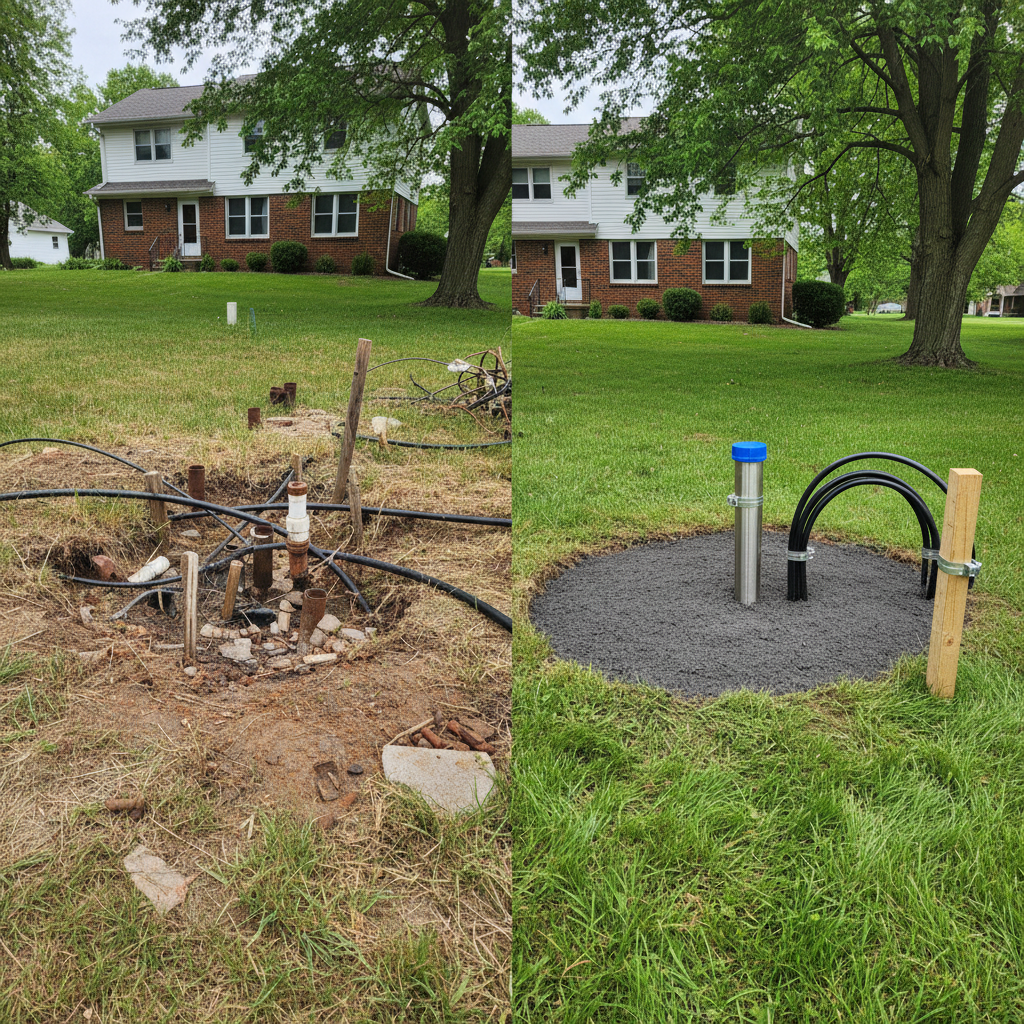
You're looking at drilling on your property, and you've probably heard a few terms thrown around: 'well drilling,' 'geothermal,' 'environmental drilling.' It can get confusing fast. What's the real difference, and which one makes sense for your place here in Kalamazoo? I'm going to lay it out plain for you, comparing two common reasons folks call us for drilling: a traditional water well versus a geothermal system.
What We're Actually Talking About
When I talk about a 'traditional well' for a homeowner, 99 times out of 100, we're talking about a water well. That's a hole we drill to tap into an underground aquifer, bringing fresh, natural water right to your house. It's for drinking, bathing, irrigation – all your water needs.
Geothermal drilling, on the other hand, isn't about getting water for consumption. It's about using the earth's stable temperature to heat and cool your home. We drill a series of loops deep into the ground, and a fluid circulates through them, exchanging heat with the earth. In winter, it brings heat up; in summer, it pulls heat out. It's a closed-loop system, totally separate from your drinking water.
Cost: Upfront vs. Long-Term
Let's not beat around the bush; cost is a big factor for everyone. Installing a traditional water well is generally less expensive upfront than a full geothermal system. You're looking at the cost of drilling, casing, a pump, and a pressure tank for a water well. It's a significant investment, but it's usually a one-time thing that pays for itself pretty quickly by eliminating water bills.
Geothermal? That's a different beast. The drilling itself is more extensive – often multiple boreholes, sometimes deeper, depending on your property and energy needs. Then you've got the indoor heat pump unit, ductwork modifications, and all the associated plumbing. The initial sticker price for a complete geothermal system is definitely higher. We're talking tens of thousands of dollars more than a water well.
But here's where it gets interesting: operating costs. Once that geothermal system is in, your heating and cooling bills can drop dramatically. I've seen folks cut their energy consumption by 50-70%. Over 10, 15, 20 years, those savings can absolutely make up for the higher upfront cost. It's a long-game investment.
Durability and Maintenance
Both systems, when installed right by pros like us at Mighty Well Drilling, are built to last. A good water well can give you trouble-free service for decades. The pump might need replacing every 10-15 years, and you'll want to check your pressure tank periodically, but the well casing itself is incredibly durable. Maintenance is pretty minimal – maybe an occasional water quality test or pump check.
Geothermal systems are also very durable. The underground loops are typically guaranteed for 50 years or more; they're buried deep, away from the elements. The indoor heat pump unit has a lifespan similar to a high-efficiency furnace or AC unit, maybe 15-25 years. Maintenance is similar to a traditional HVAC system: filter changes, annual check-ups. The big difference is the outdoor unit isn't exposed to weather, so it tends to last longer.
Appearance and Space Considerations
This is an easy one. A traditional water well is pretty discreet. You'll have a well cap at ground level, maybe a small well house or shed if your pump is above ground (though most modern systems have submersible pumps). The pressure tank usually goes in your basement or utility room. It doesn't take up much visible space outside.
Geothermal systems are even more invisible, in a way. The drilling happens, and then everything goes underground. There's no noisy outdoor compressor unit, no big condenser fan. All you'll see is the indoor heat pump unit, which looks a lot like a furnace. This is a huge plus for curb appeal and for folks who don't want mechanical equipment cluttering up their yard.
What About Kalamazoo Conditions?
Here in Kalamazoo, we've got some pretty good conditions for both. Our groundwater is generally accessible and of good quality for drinking wells, though you always want to test it. The soil conditions, especially the sandy loams and clays we often hit, are usually suitable for geothermal loops. We don't have a lot of solid bedrock close to the surface in most areas, which can make drilling easier and more cost-effective for both types of systems.
The long, cold Michigan winters and hot, humid summers make geothermal an especially attractive option for energy savings. You're getting both heating and cooling from one super-efficient system.
My Honest Recommendation
Look, if you're on municipal water and just want to save money on your heating and cooling bills, and you're willing to make a larger upfront investment for significant long-term savings and environmental benefits, geothermal is an incredible option. It's clean, quiet, and incredibly efficient, especially with our Michigan climate.
However, if you're not on city water, or you're looking to get off it, a traditional water well is non-negotiable. You need water! And even if you are on city water, a private well can be a fantastic way to eliminate a monthly bill and have a reliable, independent water source for irrigation, pools, or just peace of mind. Many folks even put in a well for irrigation and keep city water for the house. It all depends on your priorities and budget.
Ultimately, both are smart investments in your property. What we do at Mighty Well Drilling is help you figure out which one, or maybe even both, makes the most sense for your specific situation. Give us a call, and we can talk through your property, your needs, and what the ground beneath your feet can offer.